Mark Wyrd
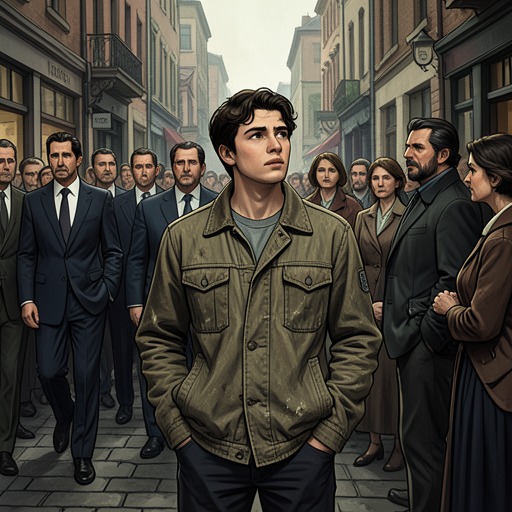
The Legend of William OhMark Wyrd is introduced as a young Climber shaped by family privilege and accustomed to the advantages that privilege provides. His importance lies in the contrast between what he expects Lordship to be and what the Tower demands of anyone who seeks it: not merely a grand title or inherited prestige, but the willingness to enter danger, seize an objective, and bind other Climbers to his authority. His arc therefore moves from romanticized ambition toward practical rule, though the evidence also preserves his impatience, entitlement, and dependence on the Wyrd name.
Identity and Background
Mark belongs to the Wyrd family, whose green-and-cream standards bear a distinctive symbol. The family is socially prominent enough that its relations matter beyond personal feeling: Alicia Zodiac was repeatedly seen with Mark, and Steve Holland understood their association against the background of tension between their fathers. Steve did not describe that hostility as a blood feud, but it was serious enough to make the relationship appear, from the outside, like a forbidden romance. The account remains unresolved because neither Alicia nor Mark is alive to explain what their connection meant.
Mark’s position is also connected to Lordship. When he first sees Oilton, he recognizes it as a city producing oil from the inexhaustible landscape of The Tower, yet the place falls short of the grandeur he had imagined for his first Lordship. He had pictured either a hostile wilderness on the Eleventh Floor, where he would fight to advance civilization, or a gleaming golden city. Oilton occupies the less romantic space between those fantasies. That disappointment reveals both his elevated expectations and the extent to which he has treated Lordship as an imagined destiny before confronting its actual burdens.
Ambition and the Test of Action
Mark’s expectations do not make him passive. Approaching Oilton, he considers the possibility that he may have to fight toward the water tanks, and the prospect gives him an unusual sense of satisfaction. His daily life apparently lacks the direct challenge of consequential work; the possibility of having to earn his Lordship through action has a certain charm precisely because it would force him beyond routine privilege. He therefore occupies an unstable position between entitlement and aspiration: he expects authority, but he is also attracted to the proof of competence that authority requires.
That tension becomes concrete when Mark orders his force to set a course for the water tanks. Rather than waiting for a safe or ceremonial path, he accepts that the objective may require an assault. His command places the army behind him in motion, with Old Bron organizing the attack. The water tanks are not merely scenery in this episode; they become the point around which Mark’s claim to rule is tested. His imagined Lordship must be translated into a decision, a route, and a willingness to expose his followers to danger.
Lordship and the Wyrd Name
Mark’s authority is inseparable from the family identity he carries into the Tower. The Wyrd standards make that identity visible, and Travis specifically identifies the green-and-cream banners as belonging to the Wyrd family. Their unusual emblem becomes the occasion for Will’s attempted joke, which Loth cuts off before it can develop. The moment is comic, but it also shows how the family name operates: it is recognizable enough to be identified immediately, and its symbols accompany Mark as a public sign of political power.
The contrast between the banner and Mark’s conduct is significant. A standard can announce lineage before its bearer has demonstrated judgment. Mark, however, cannot rely on heraldry alone when the route to Lordship leads through an active objective and a potentially hostile city. His order concerning the water tanks is thus a practical counterpart to the family crest. The name gives him a position from which to command; the decision to advance determines whether that position can become effective rule.
Vassals and the Shape of Rule
Mark’s clearest act of formal authority comes when he selects twelve young Climbers to become his first Vassals. He instructs them to swear fealty and, as one, they kneel before him. The ceremony establishes a hierarchy in a single physical image: Mark remains standing while the twelve Climbers lower themselves, transforming his personal claim into a network of subordinate allegiance.
Yet the scene also exposes his impatience with inherited ceremony. Mark omits much of the grandstanding and speech that Old Bron had prepared for him, preferring a direct command to an elaborate performance of sovereignty. Old Bron appears ready to object, but holds his tongue. Mark’s rule therefore begins with both continuity and deviation. He accepts the institution of Vassalage and the obedience it produces, while stripping away part of the ritual meant to dignify it. The result is efficient, but it also suggests that he understands authority first as something to be exercised rather than explained.
Death, Absence, and Narrative Significance
Mark’s surviving significance is shaped by the fact that his corpse later cannot be found. After the dead are recovered from the ice and the loot is divided, Mark Wyrd’s body is specifically absent. This absence complicates the earlier assumption that his story has ended and preserves uncertainty around both his fate and the unresolved connection with Alicia Zodiac. Steve’s explanation that none of the people involved are alive to tell their drama is therefore not fully matched by the evidence: Alicia’s death is treated as settled, while Mark’s missing corpse leaves a gap.
That gap gives Mark a distinctive place in the narrative. He is at once a family representative, a would-be Lord, a commander, and a possible survivor whose disappearance interrupts the ordinary finality of death. His trajectory begins with the scale of aristocratic expectation, passes through the practical demands of assault and allegiance, and ends in an absence that resists clean closure. Mark’s importance is consequently less that of a completed heroic transformation than of an unfinished political possibility: the Wyrd name has been placed beside real danger, real followers, and an objective that must be taken, but the missing body prevents the story from granting his Lordship a definitive conclusion.